
The 10 November date for mandatory CMMC Level 2 certification came and went. Here's what the suspension paused, what still applies to UK suppliers in US defence supply chains, and what to do while the reform review runs.
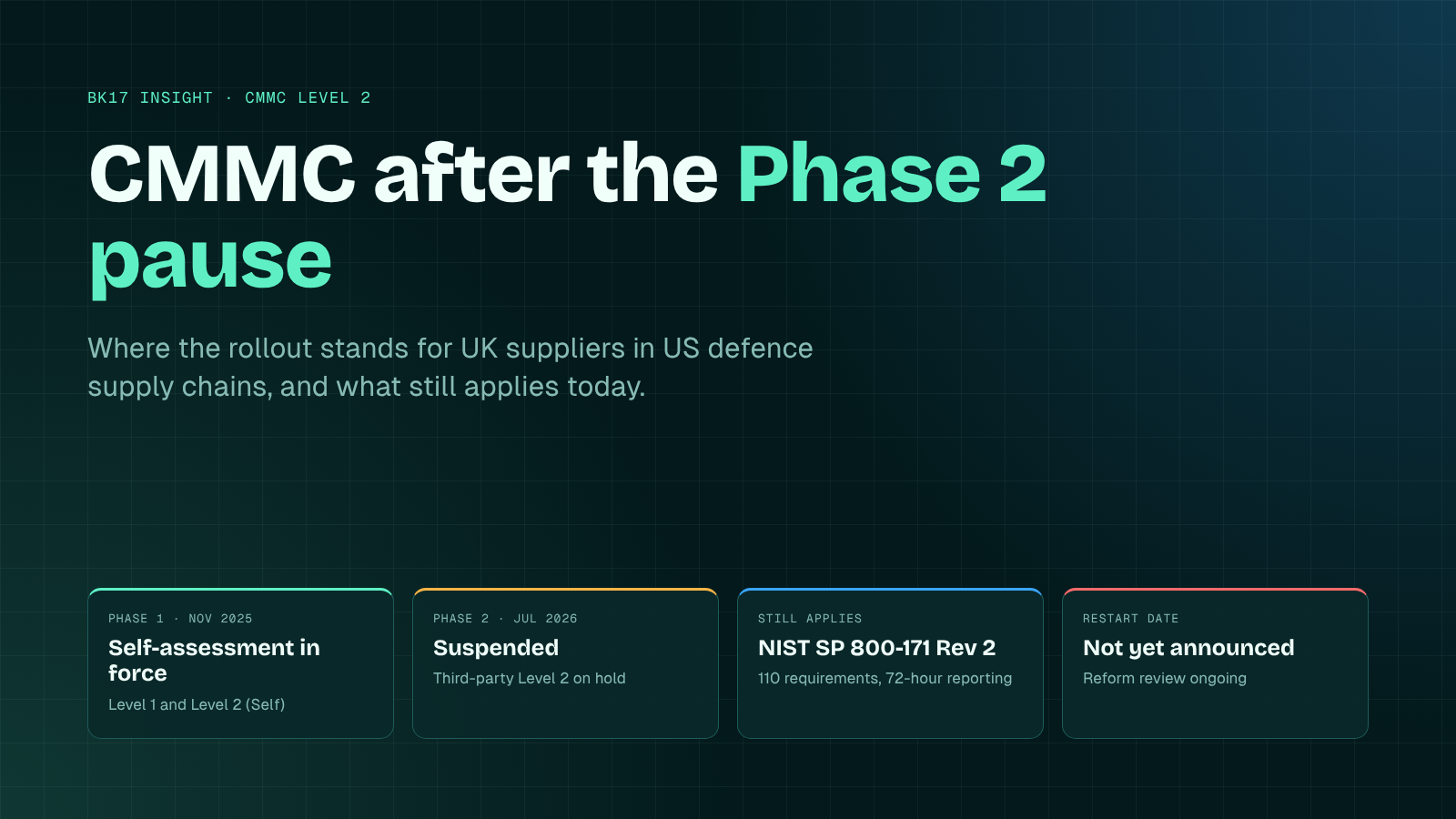
On 10 November 2026, CMMC Level 2 certification was meant to become a condition of winning US defence work. If you supply a US prime from the UK, you've probably spent the past year hearing that date in supplier briefings and seeing it in purchase order terms.
It came and went without that change. In July the US Department of Defense, which now also calls itself the Department of War, suspended Phase 2 of the Cybersecurity Maturity Model Certification programme. A reform task force was given 60 days to review the whole scheme. That review should have reported in September, but at the time of writing nothing has been published and there's no new start date.
So where does that leave a UK engineering firm, software house or component maker with US defence customers? With less pressure from the certificate and more pressure on the self-assessment. The certificate is what got paused. The obligation to protect the information never was.
Why it matters to UK suppliers
CMMC doesn't care where you're based. If your contract, or your customer's subcontract with you, involves Federal Contract Information (FCI) or Controlled Unclassified Information (CUI), the requirements follow the information. There's no exemption for national equivalents and no read-across from ISO 27001 or Cyber Essentials. Holding those is useful, but it doesn't count as CMMC.
The flow-down is written into the clauses. DFARS 252.204-7012 has to be included in subcontracts that involve covered defence information, with only the party names changed. DFARS 252.204-7021, the CMMC clause, goes further. Before a prime awards you a subcontract that involves FCI or CUI, it has to check you hold the right CMMC status and that your affirmation of continuous compliance is in place.
So for most UK suppliers, the person asking about CMMC isn't the Pentagon. It's your customer's supply chain team, and they ask because the clause makes them.
Where the rollout actually stands
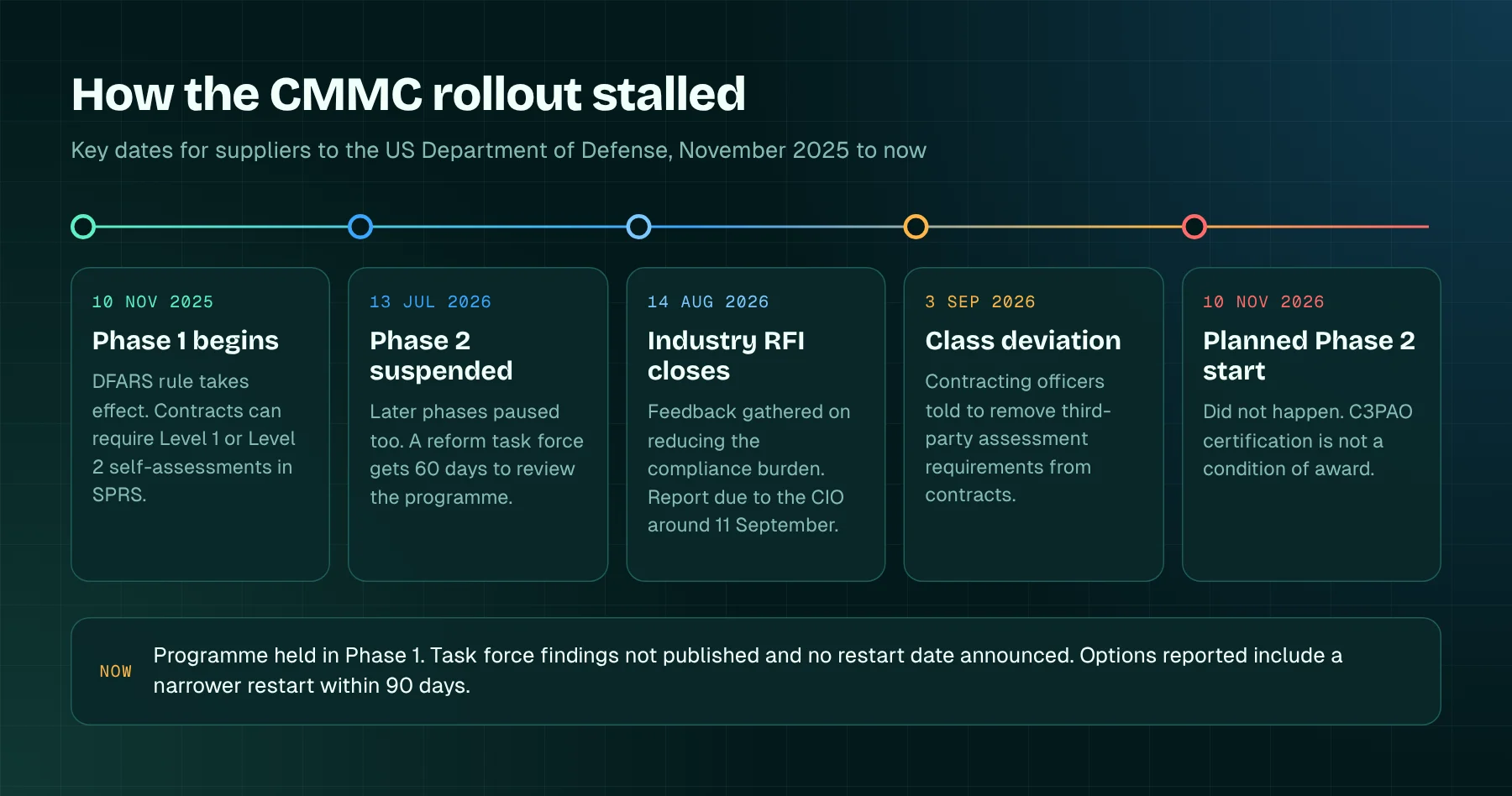
Here's the sequence, as briefly as I can put it.
Phase 1 started on 10 November 2025, when the DFARS rule bringing CMMC into contracts took effect. From then, solicitations could require Level 1 or Level 2 self-assessments, posted to the Supplier Performance Risk System (SPRS) with an annual affirmation.
Phase 2 was due on 10 November 2026. For most contracts involving CUI, the default would have moved from self-assessment to a third-party assessment by a C3PAO, an organisation authorised to carry out CMMC certification assessments.
On 13 July 2026 the department suspended Phase 2, along with the later phases. The memo was signed by the department's CIO, Kirsten Davies, on 10 July. Her reason was capacity. More than 100,000 defence industrial base companies would need third-party assessments, and only about 100 approved third-party assessors exist to carry them out. As she put it to DefenseScoop, "the math just simply doesn't math" for small and mid-sized firms.
A request for information closed on 14 August, and the task force's report was due to the CIO around 11 September.
On 3 September a class deviation told contracting officers to remove third-party assessment requirements from contracts and solicitations. That matters because it turns a policy pause into a binding contracting instruction, which is harder to reverse at short notice.
Now: the department's own CMMC page says the programme is held in Phase 1 and that the Phase 1 self-assessment requirements "remain firmly in place". Reporting in late October said the options under discussion included restarting Phase 2 within 90 days, possibly for a narrower group of contractors first, and a longer window for closing plans of action. Those are options, not decisions. Officials haven't ruled out bigger changes either.
My read? Plan for third-party assessment coming back in some form, on a timetable nobody can give you yet. Don't plan for it disappearing.
What's paused and what isn't
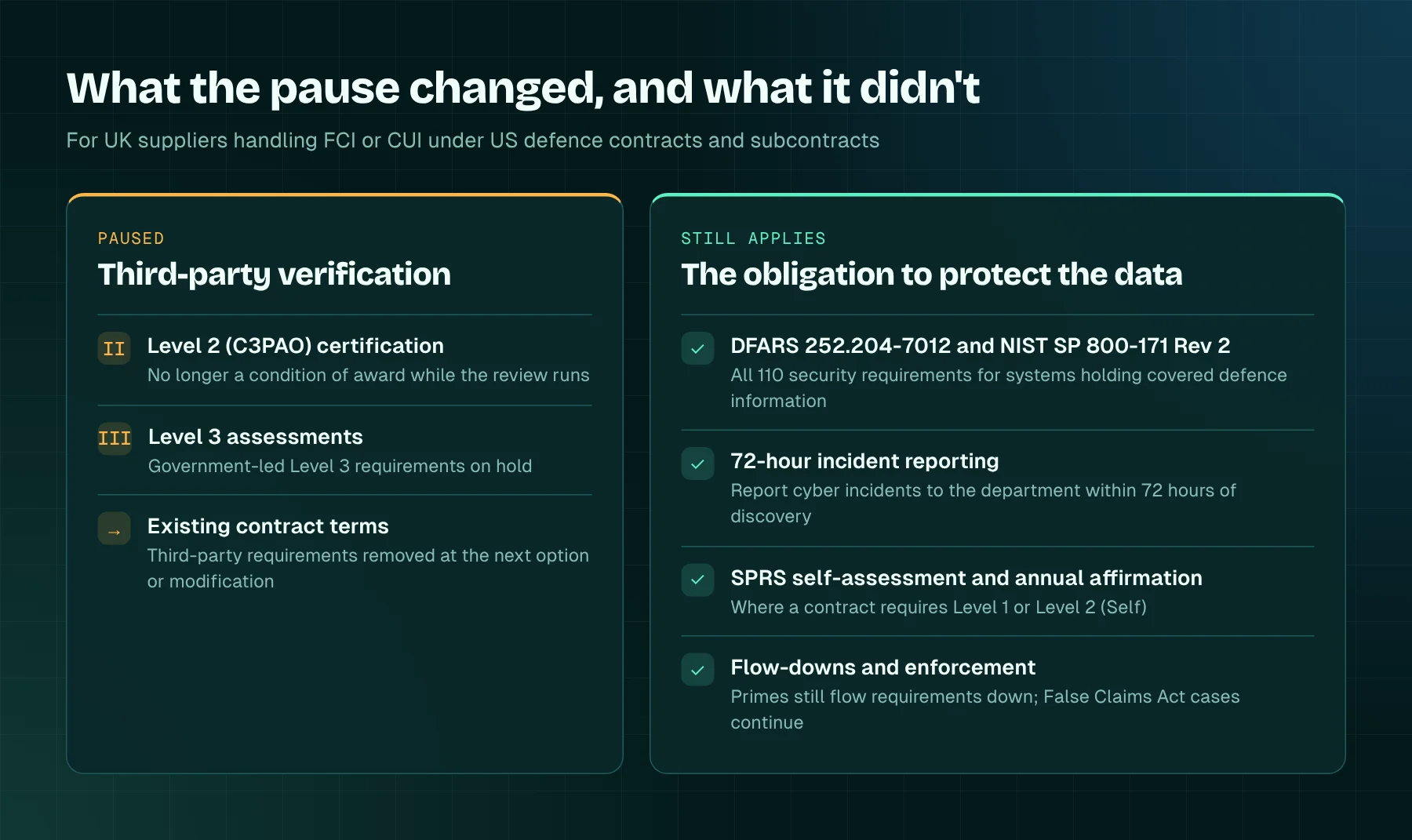
What's paused is the requirement to hold a C3PAO certificate as a condition of award, plus Level 3 assessments. Existing contracts are being modified to strip those requirements out, usually at the next option period or modification.
Everything else stays:
- DFARS 252.204-7012. If you hold covered defence information, your systems must meet the security requirements in NIST SP 800-171. The department is enforcing Revision 2 during the pause.
- Incident reporting. Cyber incidents affecting covered defence information must be reported to the department within 72 hours of discovery.
- Cloud services. If CUI sits in a cloud service, the provider must meet security requirements equivalent to the FedRAMP Moderate baseline.
- Self-assessments and affirmations. Where a contract calls for Level 2 (Self), you score yourself against all 110 requirements, post the result to SPRS, repeat the assessment every three years and affirm continuing compliance every year.
- Your customers' terms. Primes still have to flow down the cyber requirements. Some may keep asking for more than the minimum. Get any change to their expectations confirmed in writing.
Then there's enforcement. The US Department of Justice has kept pursuing False Claims Act cases over NIST SP 800-171 gaps. In June it announced a $507,144 settlement with an Alabama contractor that a government assessment had scored at -170 on a scale running from -203 to 110. In September it announced a settlement of just over $2 million with an aerospace business unit. In both cases the department said the claims were allegations only, with no finding of liability.
That's the point UK boards tend to miss. With no third party checking, your self-assessment and your annual affirmation are the evidence. A senior person is putting their name to a statement of compliance. If the score in SPRS doesn't match what an assessor would find, the pause hasn't reduced your risk. It has moved it onto that signature.
The technical substance: Level 2 in brief
Level 2 is the 110 security requirements of NIST SP 800-171 Rev 2, assessed using the methods in NIST SP 800-171A and scored under the CMMC scoring methodology in 32 CFR 170.24. Each unmet requirement deducts points from 110, and some are worth more than others.
You can get a conditional status with gaps, but the rules are tight. They're set out in 32 CFR 170.21:
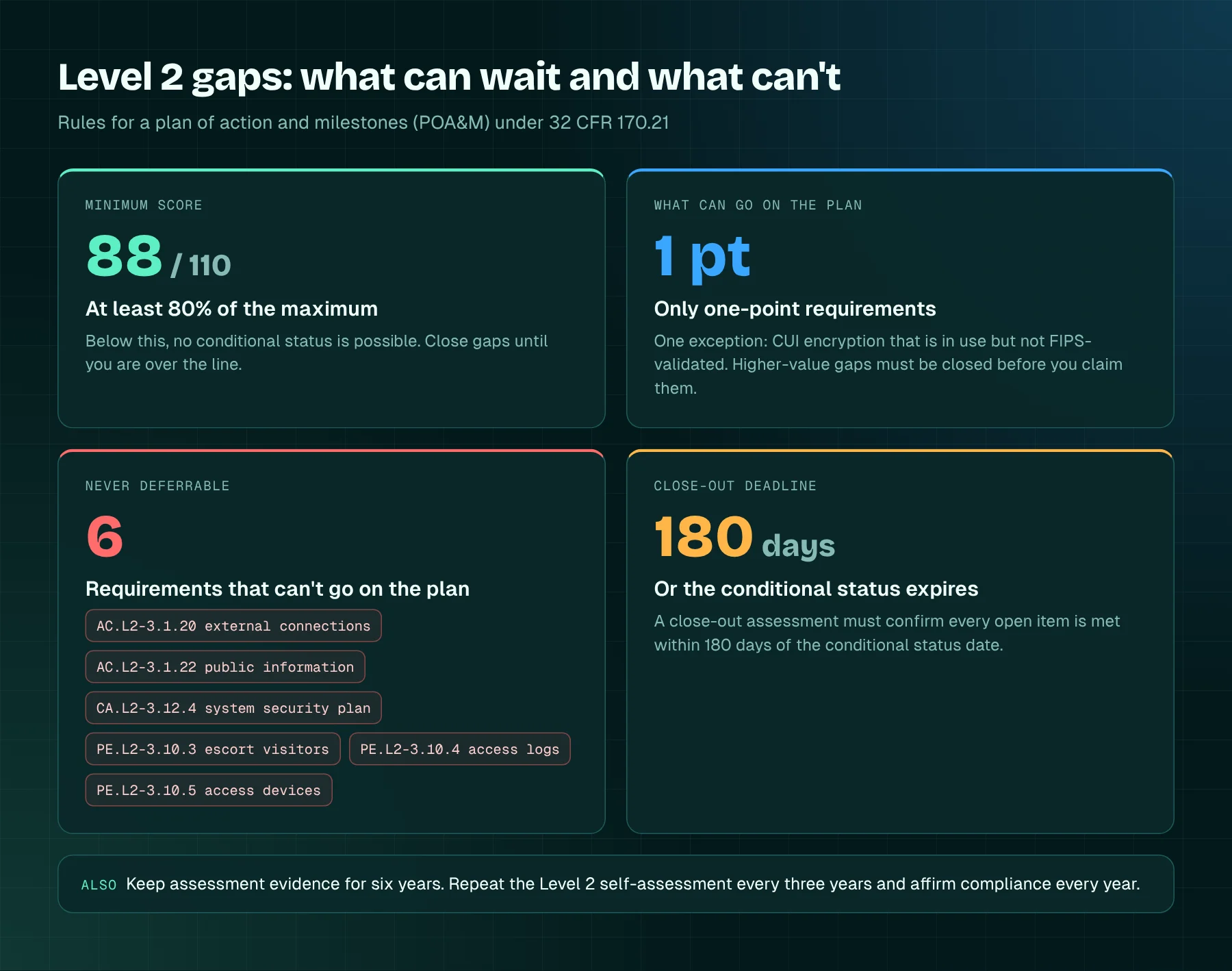
- your score must be at least 80% of the maximum, which is 88 out of 110;
- only requirements worth one point can sit on the plan, with one exception for encryption that's in use but not FIPS-validated;
- six requirements can never go on the plan: external connections (AC.L2-3.1.20), control of public information (AC.L2-3.1.22), the system security plan itself (CA.L2-3.12.4), and the three physical access requirements on escorting visitors, access logs and managing physical access devices (PE.L2-3.10.3 to 3.10.5);
- you must close the plan out within 180 days, or the conditional status lapses.
In practice that rules out the "we'll document it later" approach. If there's no system security plan, there's no conditional status. And the higher-value requirements, such as multi-factor authentication or audit logging, have to be done before you claim them.
Two more details matter for UK firms. You have to keep the evidence behind your assessment for six years. And if a government assessment under DFARS 252.204-7020 finds a different picture, its result overrides your own.
What to do now
- Find the CUI. Ask your US customers in writing which contracts involve FCI or CUI, and which data is marked. Then trace where it actually lives in your business: email, file shares, engineering tools, laptops and any cloud services. Scope is where most Level 2 efforts go wrong.
- Shrink the boundary. If CUI touches only one team, an enclave for that team is far cheaper to secure and evidence than the whole company.
- Write the system security plan first. It can't be deferred, and every other control points back to it.
- Score yourself honestly. Use NIST SP 800-171A's assessment objectives, not a yes or no questionnaire. Each requirement has several objectives, and they all have to be met.
- Fix the high-value items before the one-pointers. MFA, encryption, logging and incident response tend to carry the heaviest deductions.
- Test your 72-hour reporting. Run a short exercise. Who decides it's a reportable incident? Who submits the report? Does anyone in the business have the access needed to report?
- Treat the affirmation as a board matter. Agree who signs it, what evidence they see first and how often it's reviewed.
- Keep an eye on the restart. If Phase 2 returns on a 90-day footing, firms already close to 110 will get assessment slots. The rest will be queuing. A voluntary third-party assessment may still be worth having if your customers value it.
If you also supply the UK Ministry of Defence, remember that Defence Cyber Certification is a separate scheme with its own requirements. Doing one doesn't satisfy the other, but much of the same evidence can serve both.
How BK17 can help
BK17 is a Registered Provider Organisation (RPO) for CMMC and for DCC. We help UK suppliers scope CUI, run a scored gap assessment against NIST SP 800-171 Rev 2, build the system security plan and work through remediation, so that your self-assessment holds up and you're ready when third-party assessment returns. We advise and prepare; the certification assessment itself is carried out by an authorised C3PAO. You can read more about our CMMC support and our wider defence work.
TheMS, our compliance management system, keeps your control evidence, plans of action and supplier flow-downs in one place. It also tracks CMMC and DCC alongside ISO 27001, so the evidence you gather for one customer counts for the next.
If your US customers are asking about CMMC, or have gone quiet since the summer, talk to us about where you stand.
Explore topics
Written by
BK17 Editorial
Content creator and writer sharing insights and stories.