
A critical Java flaw, two revised ISO standards and new UK data protection duties, all in one year. Here's how a small business keeps up without a compliance team, and how BK17 and TheMS spot, assess and plan the changes for you.
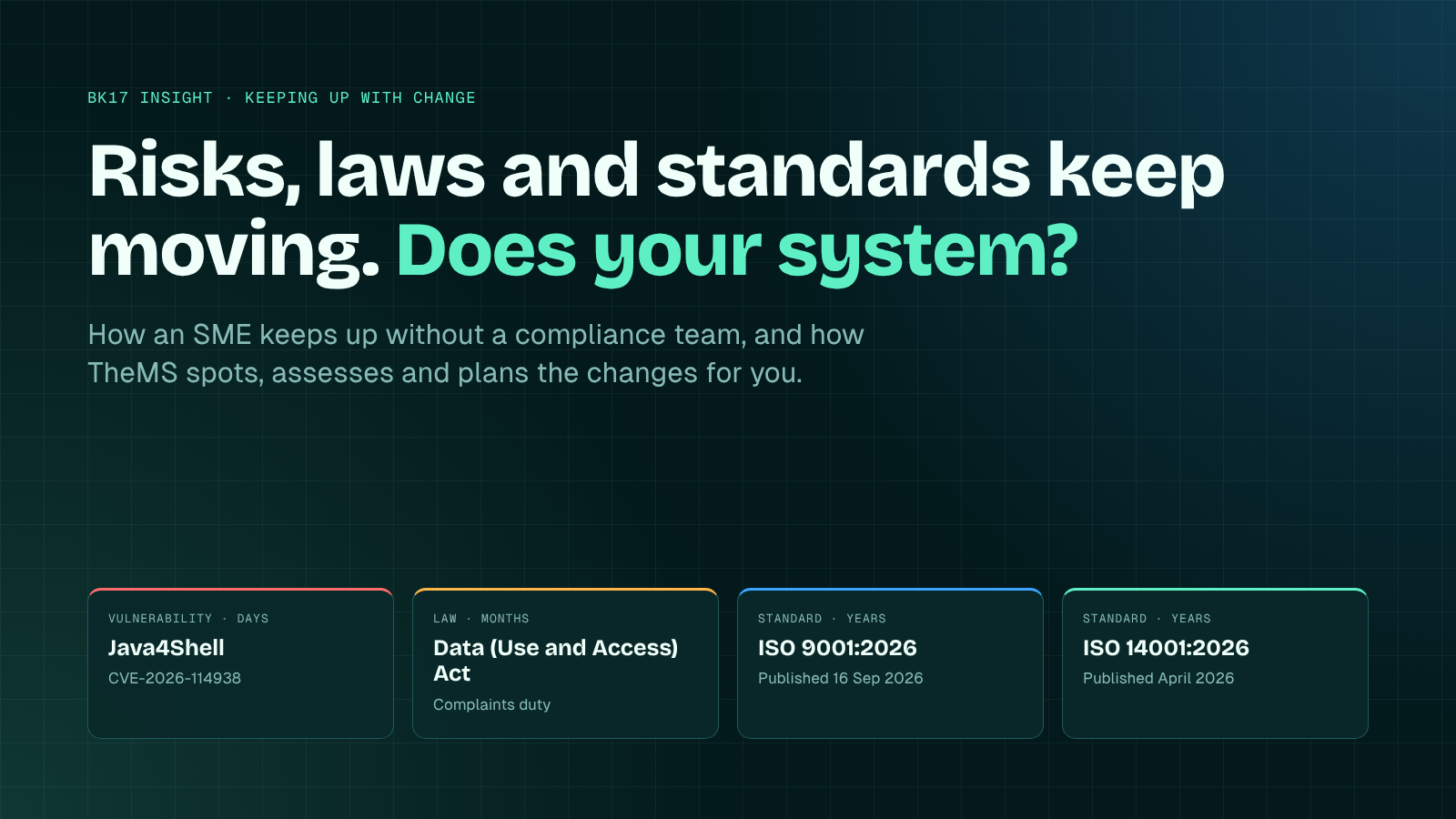
On 17 November the US cyber agency CISA told organisations to patch a Java flaw "immediately". Nicknamed Java4Shell (CVE-2026-114938), it sits in the Base64 decoder of the HotSpot Java Virtual Machine on x86-64 systems. In CISA's words, specially crafted Base64 input could crash the JVM, and it could potentially let an attacker run code remotely without logging in.
If you run a small business, here's the awkward question. Would you have heard about it? And if you had, would you know whether Java is anywhere in your estate? It rarely shows up as its own line in a software list. It comes bundled inside accounting packages, HR systems, appliances and container images.
This year, ISO 9001 and ISO 14001 both got new editions, and most of the UK's new data protection law came into force. None of it arrived with a letter addressed to you.
Why it matters
Every management system standard expects you to keep up. ISO 9001 and ISO 14001 ask you to understand your context and the requirements that apply to you. ISO 27001 expects you to gather threat intelligence (Annex A 5.7) and manage technical vulnerabilities (8.8). Cyber Essentials goes further: high and critical security updates must go on within 14 days of release. Oracle scores Java4Shell at 8.1 out of 10, so it's in that bracket.
Big firms have compliance teams who read the bulletins, decide what applies and chase the changes through. Most SMEs have a managing director, an IT supplier and good intentions. The changes still land. The difference is whether anyone notices in time.
Three kinds of change, three speeds
A vulnerability: days
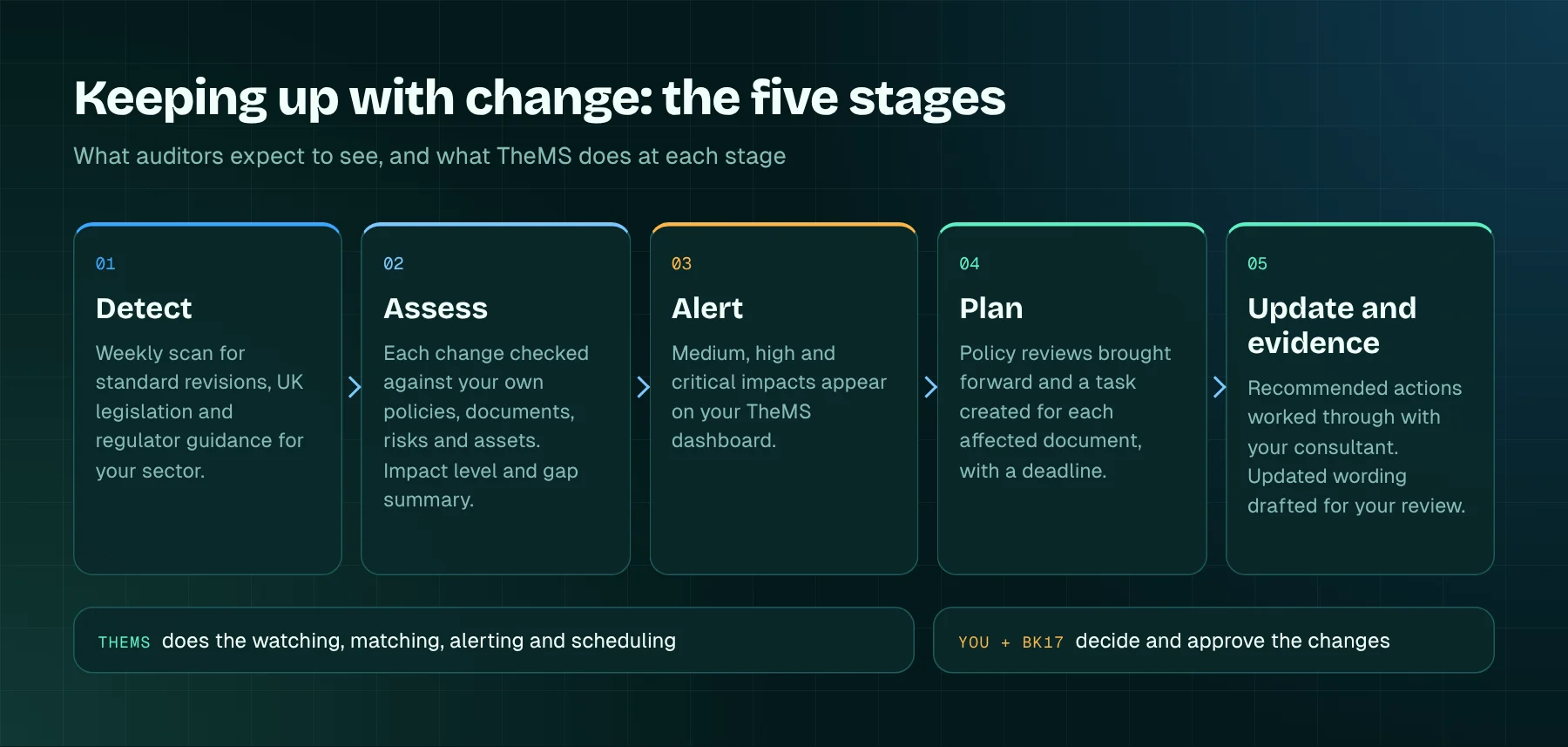
Java4Shell is the fast kind. Oracle fixed it in its November Critical Patch Update, released on 17 November, and the Linux distributions and other Java vendors followed within days. Security researchers reported exploitation attempts soon after, although no confirmed successful attack had been published when this was written.
CISA's advice maps neatly onto what auditors look for:
- Find it. Check your software inventory for Java runtimes, including the ones bundled inside other products.
- Patch it. Internet-facing systems first. If you can't patch yet, put temporary controls in place, such as limiting unauthenticated access to the affected service.
- Follow the vendor. Read Oracle's advisory and your suppliers' notices for bundled copies.
- Watch for trouble. Unexpected JVM crashes and unfamiliar Java processes are worth a closer look.
Step 1 is where small businesses usually stall. If your asset register lists laptops but not the software on them, you can't answer the question quickly. That's an ISO 27001 problem (5.9, inventory of information and other associated assets) long before it's a Java problem.
A law: months
The Data (Use and Access) Act 2025 is the slower kind. Most of its remaining data protection changes came into force on 5 February 2026. A new duty for organisations to run a formal procedure for data protection complaints was due to follow on 19 June 2026. Complaints must be acknowledged within 30 days. If you hold personal data about customers or staff, that touches your privacy notice, your complaints process and probably your ISO 27701 or GDPR documentation.
A standard: years
ISO 9001:2026 was published on 16 September 2026. ISO 14001:2026 came out in April. Both carry a transition period of about three years. Certification bodies expect it to run to around 2029, with the exact dates set by the IAF, so confirm yours with your certification body.
The changes are moderate but real:
- ISO 9001:2026 names quality culture and ethical behaviour in the leadership requirements. It separates risks from opportunities, strengthens the management of change, and makes climate change explicit in the context clause.
- ISO 14001:2026 widens the environmental context beyond climate to pollution, biodiversity and natural resources. It restructures risks and opportunities, strengthens the life-cycle view and adds requirements for planning change. It also reframes "outsourced processes" as externally provided processes, products and services.
Three years sounds generous. It isn't, once you count a gap analysis, document updates, internal audits and a management review before your certification body visits. You can read more on our ISO 9001 and ISO 14001 pages.
What good looks like
Whatever the change, the routine is the same. Auditors want to see that you:
- Watched the right sources for your standards, sector and country.
- Assessed each change against your own system, not in the abstract.
- Decided, with someone accountable and a date.
- Acted, updating the documents, controls, training or assets affected.
- Kept the evidence, so you can show the trail at the next audit.
Done by hand, that's a spreadsheet of bulletins, a folder of half-updated policies and a lot of goodwill. It works until the person who does it goes on holiday.
How BK17 and TheMS handle it for you
BK17 builds it. TheMS runs it. Our consultants build your management system once. TheMS, our compliance management system, then keeps it current as the rules move, with 1 system, 1 login and 1 renewal.
Here's what that means for change in practice:
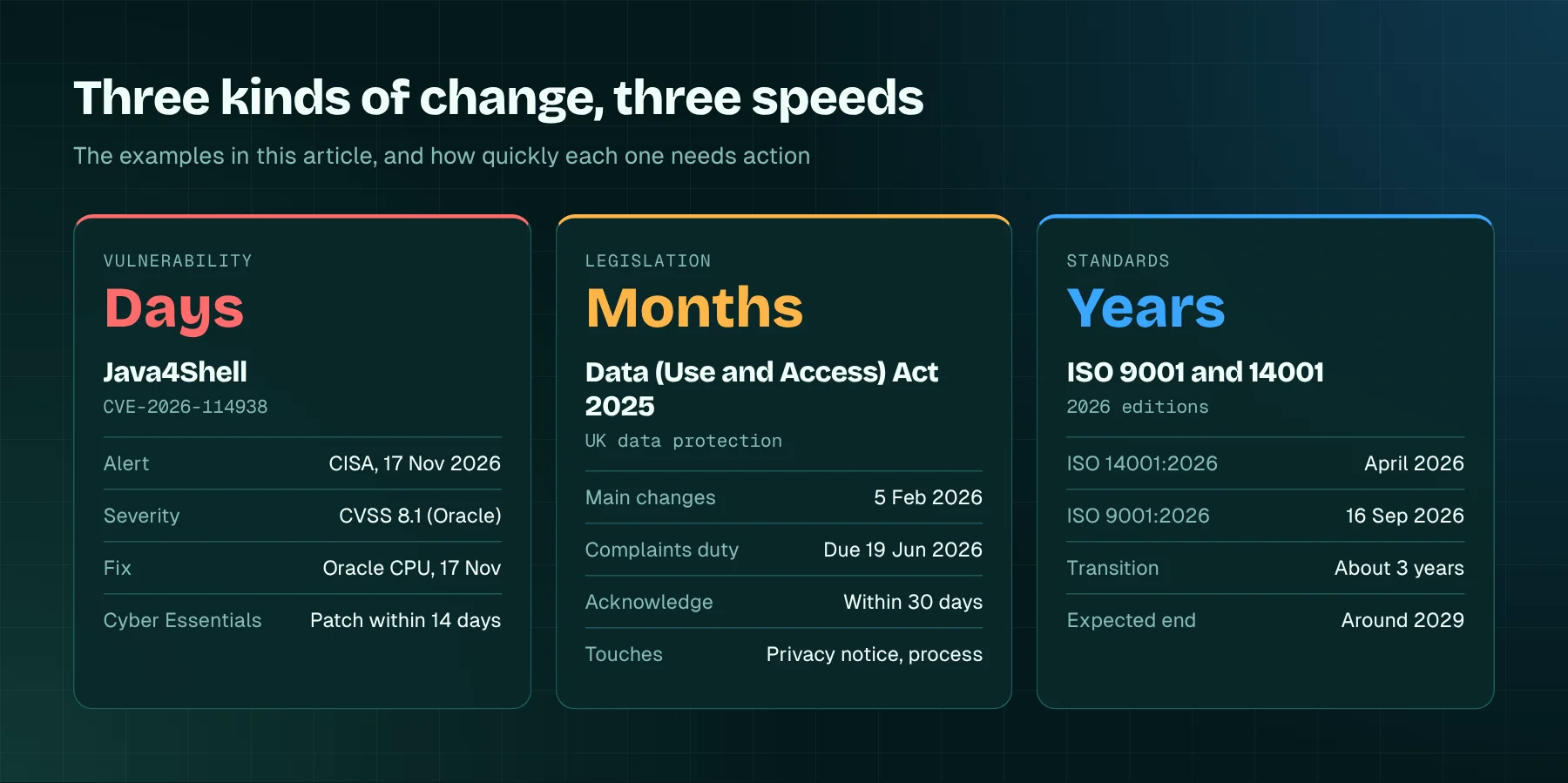
- It looks for you. Every week, TheMS scans for regulatory changes and standard revisions relevant to your country, sector and standards. That covers new ISO editions such as 9001:2026 and 14001:2026, UK legislation, and guidance from regulators such as the ICO and HSE.
- It checks what it means for you. Each change is analysed against your own policies, documents, risks, assets and tasks. You get an impact level, the specific policies and documents affected, a short gap summary and three to five recommended actions.
- It tells you. Medium, high and critical impacts appear as alerts on your TheMS dashboard. You don't have to go looking.
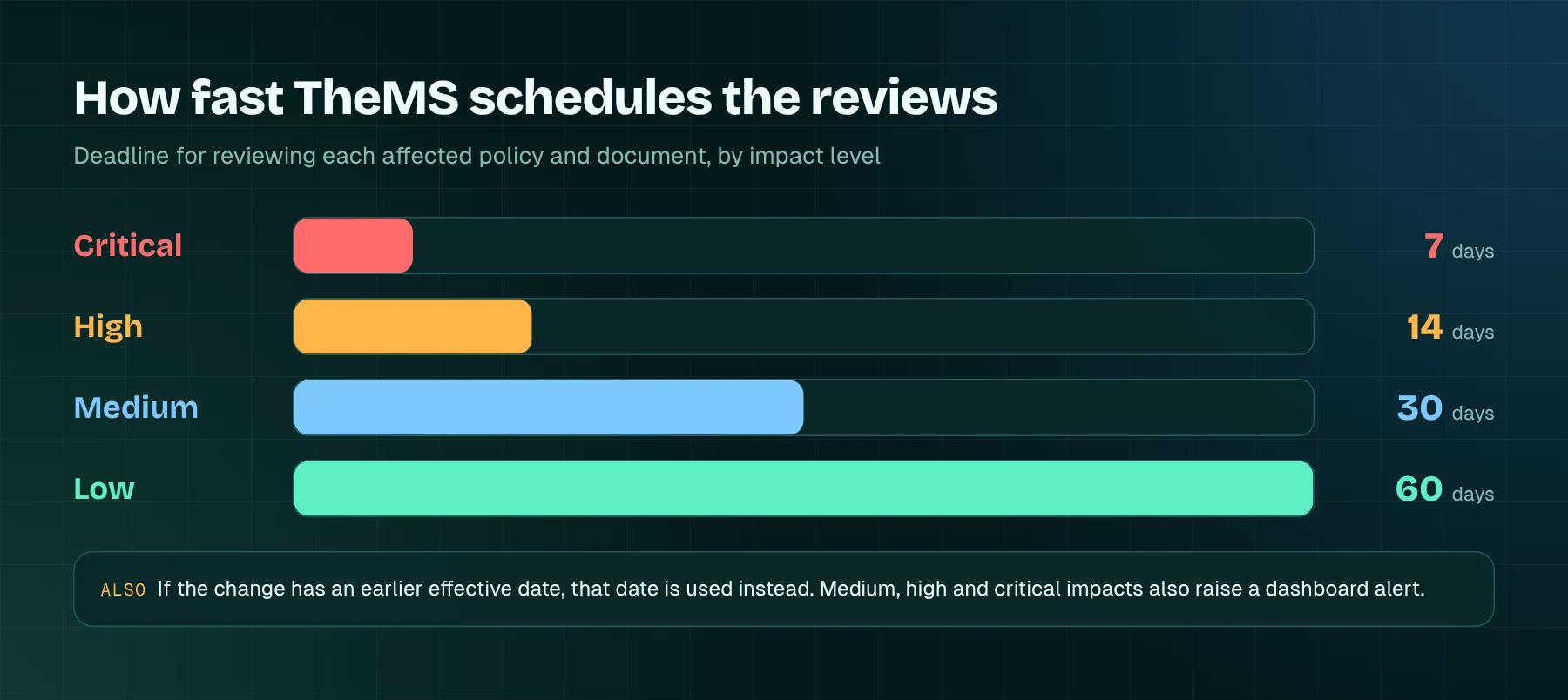
- It plans the work. TheMS brings forward the review dates of the affected policies. It creates a review task for each affected policy and document, with a deadline set by severity: within 7 days for critical, 14 for high, 30 for medium and 60 for low.
- It builds the changes with you. Your BK17 consultant works through the recommended actions with you. TheMS's AI document tools draft updated wording for your review, and the evidence sits against the relevant clauses in TheMS.
For a vulnerability like Java4Shell, the same system does the legwork. Your asset register in TheMS is where you find out which systems carry Java. You log the risk and the patching actions against named owners and dates. Then the record of what you did, and when, is ready for your Cyber Essentials or ISO 27001 assessor. Learn more about TheMS.
You don't need a compliance department to keep up. You need a system that notices change, tells you what it means and tracks the work through.
Talk to us about keeping your management system current without adding headcount.
Explore topics
Written by
BK17 Editorial
Content creator and writer sharing insights and stories.
