
On Thursday evening Outlook and Teams stopped working for organisations around the world, and for many it ran on into Friday. Here's what an ISO 22301 approach would have had ready, and what to fix before the next one.
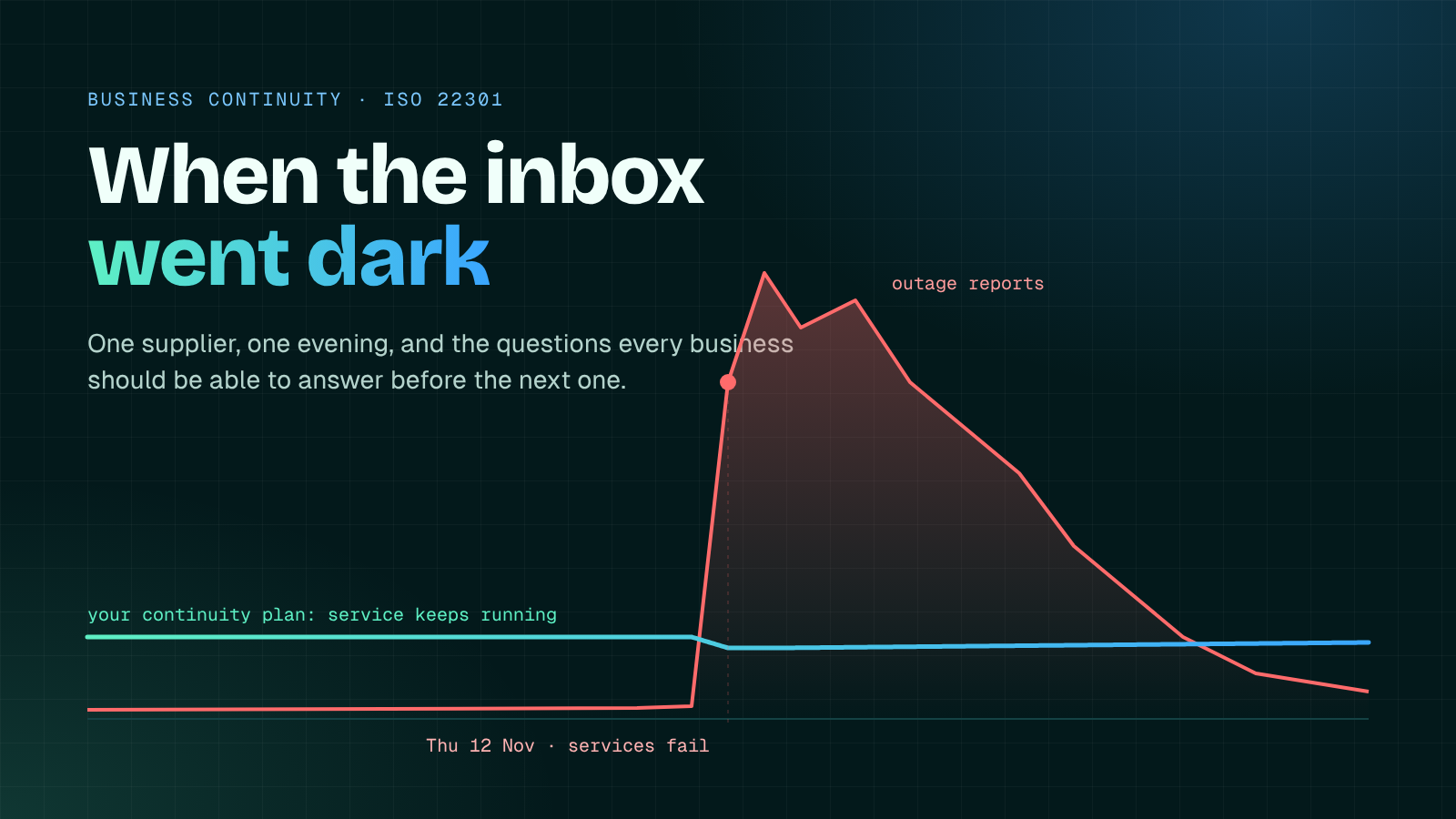
At around six o'clock on Thursday evening, UK time, a lot of organisations found out just how much of their business runs through one sign-in.
Outlook stopped sending and receiving. Teams, Copilot, OneDrive and the wider Microsoft 365 suite were disrupted too. By Friday morning it was still going on: outage trackers were logging tens of thousands of reports, and Microsoft's own updates had moved from "investigating" to "partial recovery across regions" without yet getting to "resolved". Some organisations went back to fax machines. A bond repurchase in Europe was halted.
Microsoft has said there's no sign of malicious activity. The early explanation is a capacity problem: servers that weren't available when the load came, with Exchange Online at the centre of it. A full post-incident report will follow, and it'll make interesting reading for engineers.
For everyone else, the cause matters much less than the question it leaves behind: what did your business actually do between Thursday teatime and Friday lunchtime?
We felt it ourselves: on Friday morning a routine job on our own list simply had to wait. That's an inconvenience for us. For a business with a tender deadline, a payroll run or a client expecting a contract by close of play, it's something else.
It wasn't an attack. It's still your problem.
When a cloud service goes down, the instinct is to wait. Microsoft has thousands of engineers; there's nothing you can do, so you refresh the status page and hope.
That's understandable, but it confuses two different responsibilities. Microsoft is responsible for running the service. You're responsible for what your business does when it isn't running.
The Microsoft 365 service level agreement is 99.9% uptime per month. That sounds reassuring until you do the sum: it allows about 43 minutes of downtime in a 30-day month before any service credit is due. This outage ran for many hours. And a service credit is a discount on next month's subscription. It doesn't pay for the contract you didn't sign, the client who went elsewhere or the evening your operations manager spent ringing people from a personal mobile.
What actually stopped
Most people think of an email outage as "we couldn't send email". In practice, a modern business uses its Microsoft tenant for far more than that, and plenty of it is invisible until it fails.
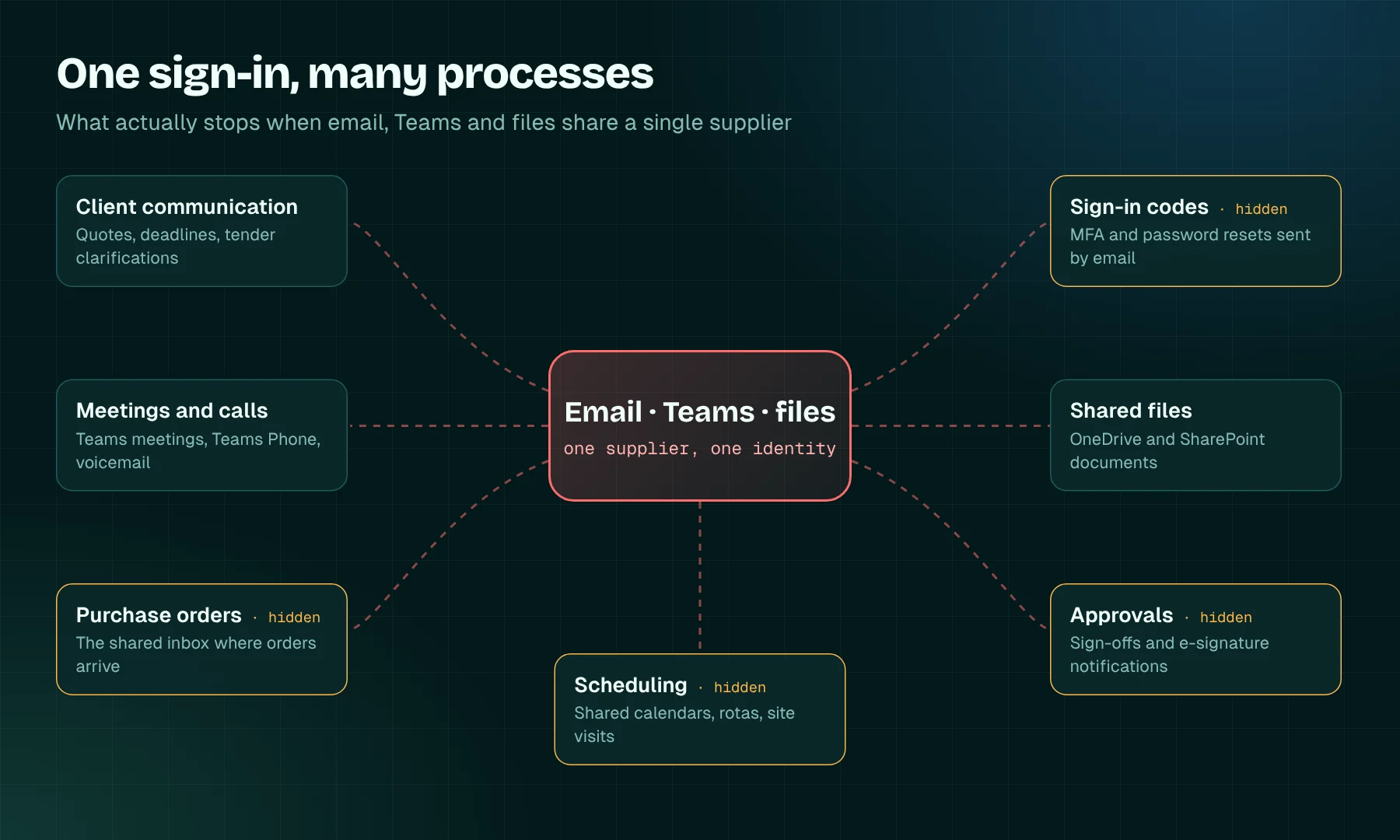
The obvious ones are client email and Teams meetings. The hidden ones are where the damage really happens:
- The shared inbox where purchase orders arrive. Nobody thinks of it as a system, but if orders stop landing, fulfilment stops too.
- Sign-in codes and password resets sent by email. If your MFA or a supplier portal relies on an email code, you can be locked out of other systems as well.
- Approvals and e-signatures. The notification never arrives, so the sign-off never happens.
- Shared calendars. Engineers, auditors and care staff turn up (or don't) based on a calendar invitation.
- Teams Phone and voicemail-to-email. If your phone system runs through Teams, your phones were exposed too.
None of this is a criticism of Microsoft 365. Consolidating onto one platform is usually the right decision: it's cheaper, more secure and easier to manage. But it does concentrate risk, and concentrated risk needs a plan.
Where ISO 22301 comes in
ISO 22301 is the international standard for business continuity management systems. The current version is ISO 22301:2019, with a 2024 amendment that adds climate change considerations. It doesn't ask you to prevent every outage. That would be impossible, and for a cloud supplier it's not in your gift anyway.
What it does ask is that you understand what matters most, how long you can survive without it, and that you've worked out and rehearsed what you'll do instead. It follows the same Plan-Do-Check-Act structure as ISO 9001 and ISO 27001, so if you already run one of those, much of the framework will be familiar.
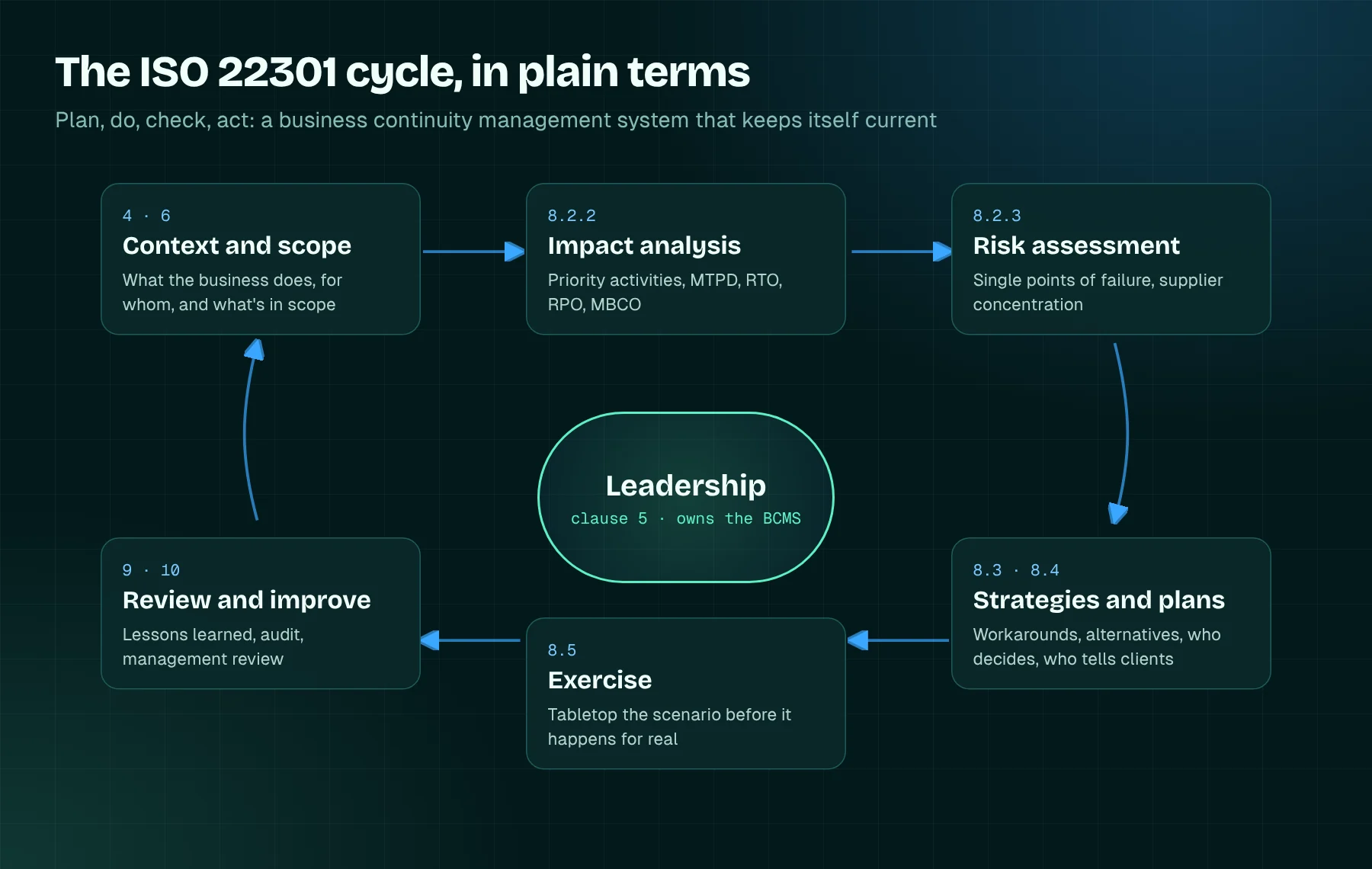
Here's how the core of it applies to Thursday's outage.
1. Business impact analysis (clause 8.2.2)
The business impact analysis is the heart of the standard, and the part most businesses skip. For each activity that delivers your products or services, you work out what happens over time if it stops. Out of that come four numbers:
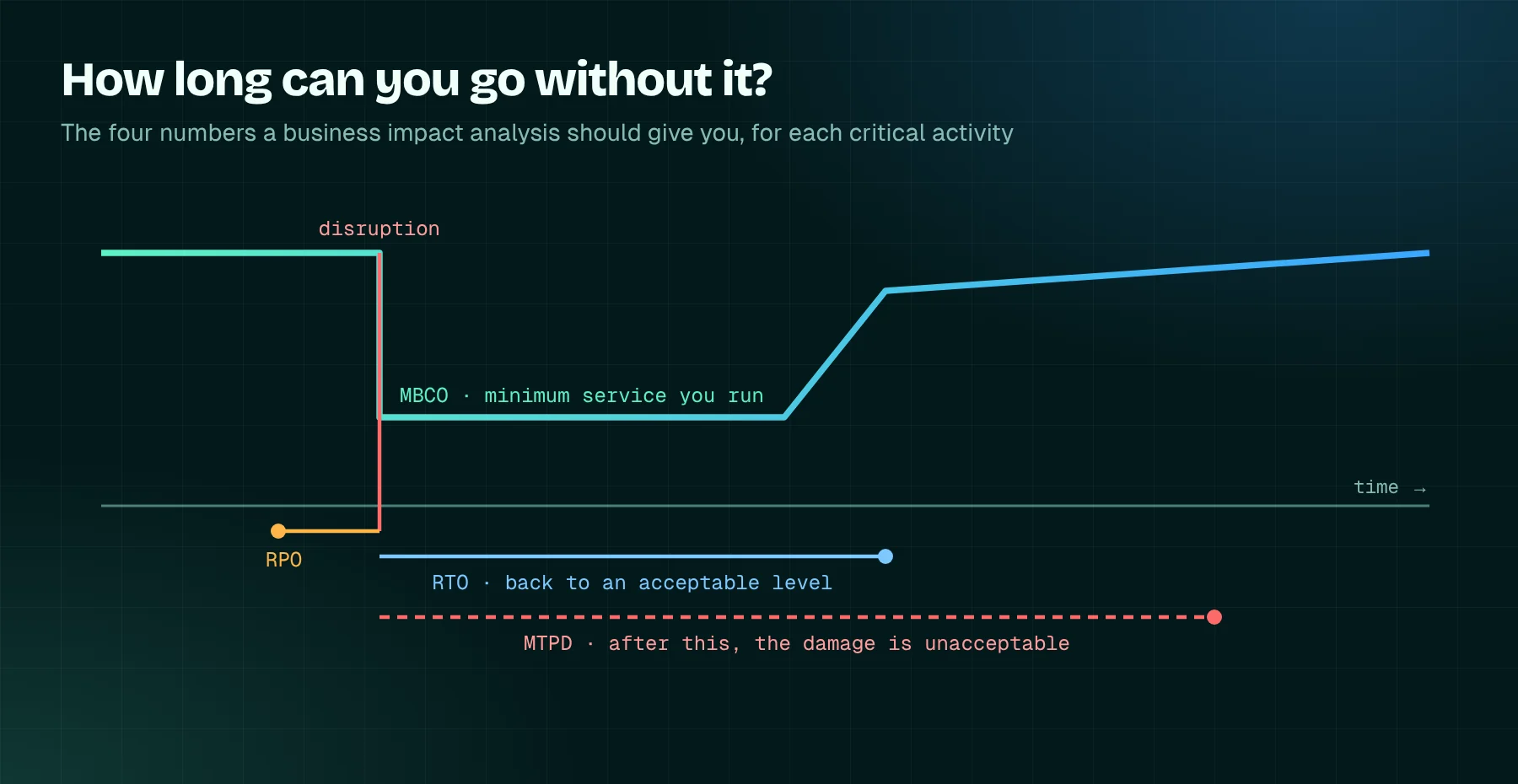
- MTPD (maximum tolerable period of disruption): how long before the damage is unacceptable. Lost contracts, regulatory breach, harm to people.
- RTO (recovery time objective): how quickly you need the activity back at an acceptable level. It has to be shorter than the MTPD, with some margin.
- RPO (recovery point objective): how much information you can afford to lose, measured back from the moment of failure.
- MBCO (minimum business continuity objective): the reduced level of service you'll run while you recover.
The numbers are different for every business. A defence supplier answering a contract clarification with a fixed deadline might have an MTPD for client email measured in hours. An accountancy practice in January might be similar. A manufacturer whose orders come through EDI rather than email might tolerate a day without Outlook but not an hour without the shop-floor system.
The point is to know your numbers before the outage, not to discover them during it. If your RTO for client communication is four hours and the supplier is still "investigating" at hour three, your plan should already be in motion.
2. Risk assessment (clause 8.2.3)
"Our main cloud productivity supplier is unavailable for more than a working day" should be on your risk register as a named scenario. So should the less obvious version: "our identity provider is unavailable", because if sign-in fails, every application that uses it fails at once.
This is also where you look at concentration. If email, chat, telephony, file storage and identity all sit with one supplier, they share a single point of failure. You may well decide to accept that risk. ISO 22301 doesn't stop you. But it should be a decision someone made, with a treatment plan, rather than an accident nobody noticed.
3. Strategies and solutions (clause 8.3)
This is where the planning turns practical. The aim isn't to duplicate Microsoft 365. It's to have a proportionate fallback for each critical activity.
| What stopped | A proportionate continuity option |
|---|---|
| Client email | An email continuity service or secondary mail route for critical mailboxes, or at minimum an agreed alternative address you can publish quickly |
| Teams meetings and calls | A conference phone bridge or a second conferencing account; staff mobile numbers kept in an offline call tree |
| Shared files | Critical folders synced for offline use on named devices; a separate backup of Microsoft 365 data (retention isn't the same as backup) |
| Sign-in | Emergency administrator accounts, held securely and monitored, for when the problem is in sign-in policy rather than the service itself |
| Telling clients | Pre-written holding statements; the ability to put a notice on your website and send text messages |
Most of these cost very little. The expensive part is the thinking, and that's what the impact analysis has already done for you.
4. Plans and procedures (clause 8.4)
A plan that only lives in SharePoint is no use when SharePoint is down. Keep the essentials in a form you can reach without your tenant: printed, on a phone, or in a separate secure location.
A good continuity plan for this scenario fits on a page or two:
- Who decides the business is in an incident, and on what trigger. For example: "Email or Teams unavailable for more than two hours in business hours."
- Who tells whom, through which channel, and what they say.
- Which workarounds start, and who owns each one.
- A decision log, so you can show afterwards what you did and why. Regulators, insurers and clients will ask.
5. Exercising (clause 8.5)
The best test of a plan is to run the scenario before it happens for real. A tabletop exercise takes an hour: "It's 17:50 on a Thursday. Outlook and Teams have stopped. A client's tender response is due at 09:00 tomorrow. What do we do?"
Almost every organisation that runs that exercise finds something: a phone number nobody has, a workaround that depends on the system that's down, a decision nobody is authorised to make. Far better to find it in a meeting room than at 10pm on a Thursday.
Then comes the part of the standard that turns a plan into a system: review what happened, fix what didn't work, and report it to top management (clauses 9 and 10). If your business was hit this week, that review should be happening now, while it's fresh.
The regulators already expect this
For some sectors this isn't optional. Under the UK operational resilience rules, firms regulated by the FCA and PRA have had to identify their important business services, set impact tolerances and show they can stay within them in severe but plausible scenarios; the transition period ended on 31 March 2025. For financial entities in the EU, DORA has applied since January 2025, with a heavy emphasis on third-party ICT risk.
If you hold or are working towards ISO 27001, two of the 2022 Annex A controls point straight at this week's events: 5.29, information security during disruption, and 5.30, ICT readiness for business continuity. An auditor looking at those controls will want to see more than a policy statement.
And in defence supply chains, frameworks like Cyber Essentials and Defence Cyber Certification concentrate on preventing compromise. Availability, the third part of the security triad, is easy to overlook until a supplier outage reminds you it's there.
Seven questions for Monday morning
If Thursday caught your business out, start here:
- Which of our activities stopped, and which carried on?
- For the ones that stopped, how long could we really have gone on like that? Have we written that down?
- Which of our "hidden" processes (orders, approvals, sign-in codes, rotas) depend on email or Teams?
- Could we reach every member of staff and our ten most important clients without Microsoft 365?
- Who had authority to declare an incident and switch to workarounds? Did they know it?
- Where is our continuity plan kept, and could we open it on Thursday night?
- When did we last rehearse a scenario like this?
If the honest answer to several of those is "we're not sure", you're not alone. It's also very fixable.
How BK17 can help
We help organisations build business continuity that works on the day, not just on paper: impact analysis workshops, continuity strategies matched to how you actually operate, plans people can use under pressure, and tabletop exercises built around scenarios like this one. Where you want formal recognition, we'll take you through to readiness for ISO 22301 certification by an accredited certification body, and we can align it with your ISO 27001 or ISO 9001 management system so it isn't another set of paperwork.
Talk to us about business continuity. It's much easier to have the conversation now than during the next outage.
Facts about the outage are as reported by Microsoft and news organisations up to Friday 13 November 2026. Microsoft's own post-incident review may add to or change the picture.
Explore topics
Written by
BK17 Editorial
Content creator and writer sharing insights and stories.