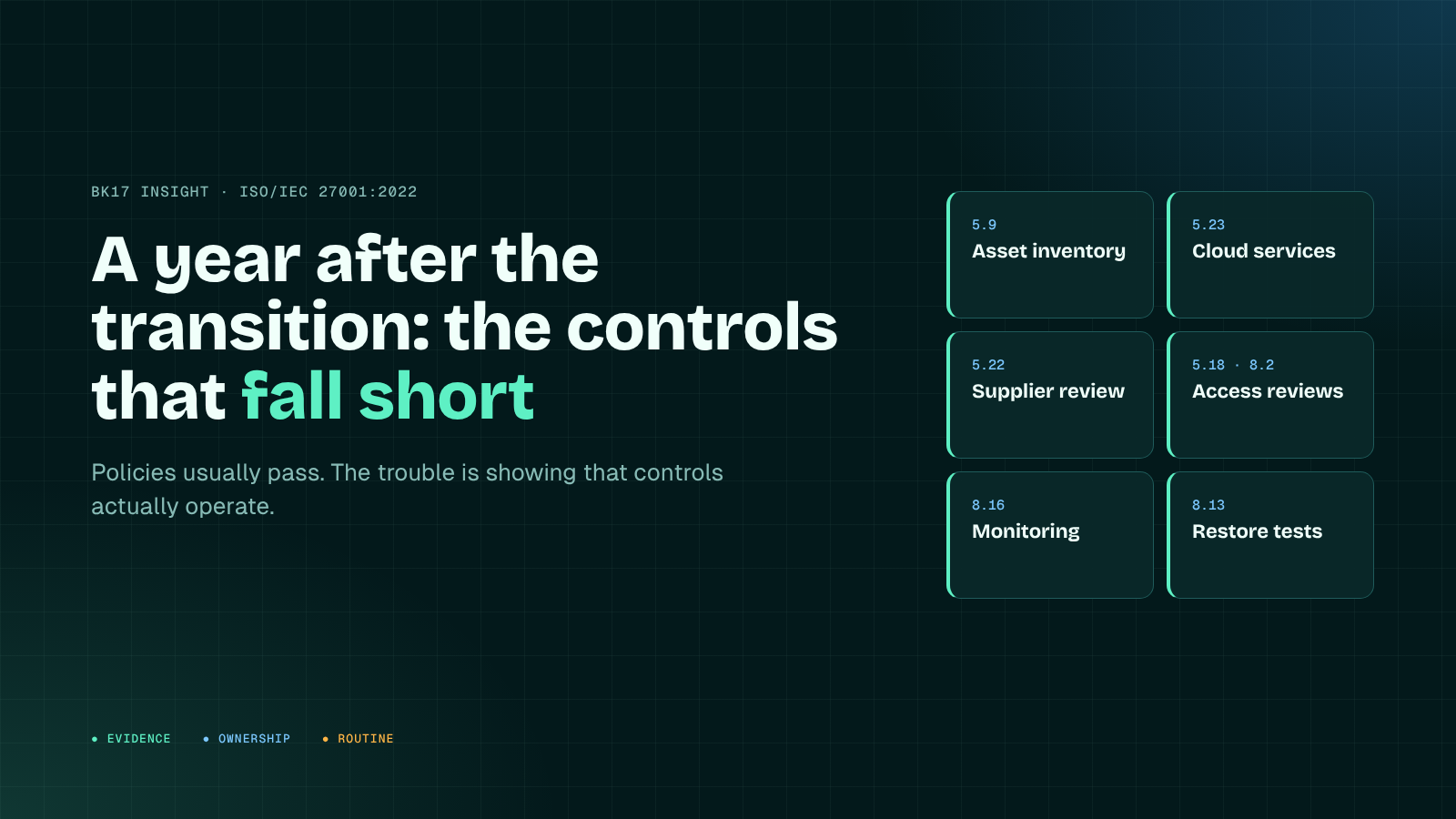
The 2013 certificates expired on 31 October 2025. A year on, quick transitions are showing their gaps: cloud services, supplier reviews, access reviews, monitoring and restore tests. Here's where to look and how to fix it without a compliance team.
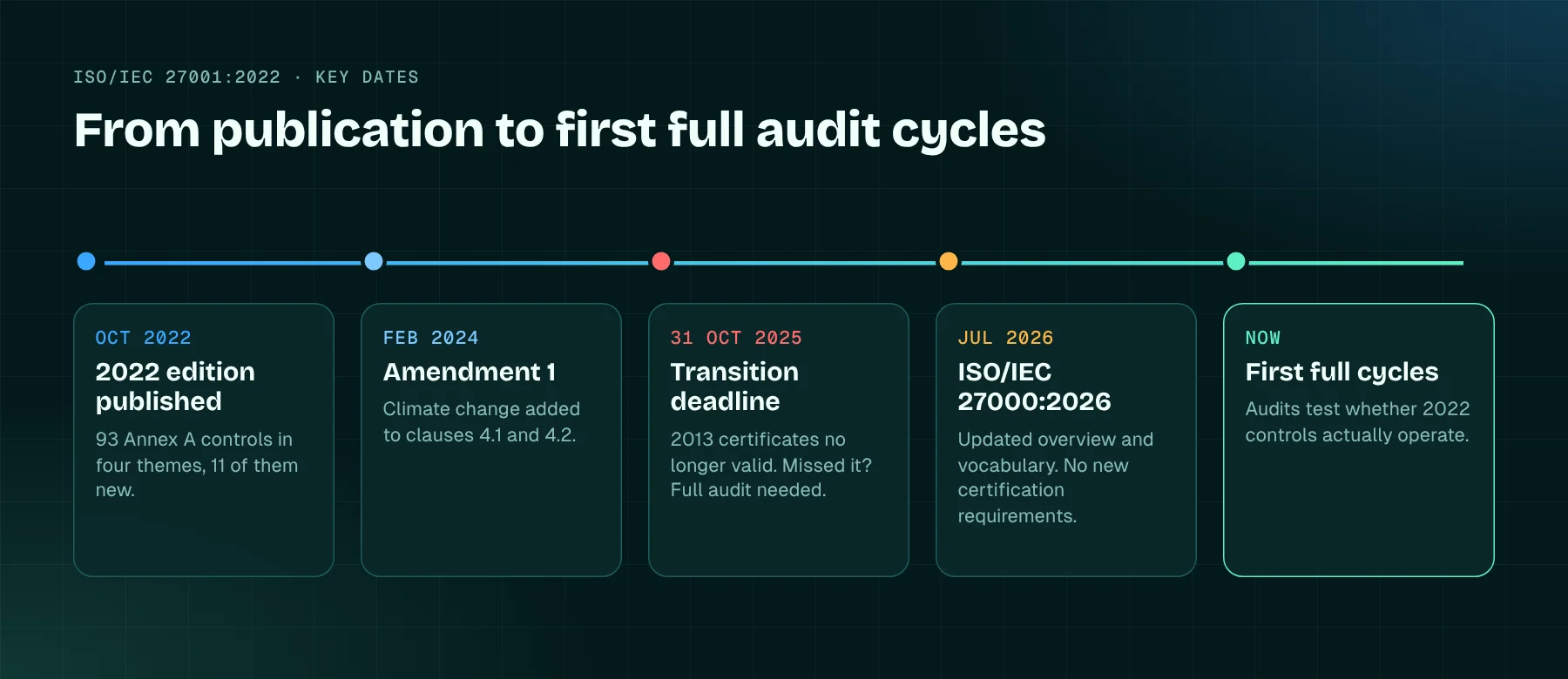
On 31 October 2025, the transition period for ISO/IEC 27001:2022 ended. Any certificate still issued against the 2013 edition stopped being valid, and organisations that missed the date had to go through a full certification audit to get back in.
Some organisations used the transition to rebuild. Others, often the smaller ones, took the quickest route they could: a mapping exercise from the old Annex A to the new one, a refreshed Statement of Applicability, a few new policies for the new controls, and a transition audit bolted onto a surveillance visit. That was a sensible way to beat a deadline. It isn't a great way to run an information security management system.
A year on, those organisations are into their first full audit cycles against the 2022 version, and the gaps are showing up in fairly predictable places. Not in the policies, which are usually fine, but in whether the controls actually operate and whether anyone can prove it.
Here's where we see the weak spots, why they matter for a small business, and what you can do about them without hiring a compliance team.
Why this matters more when you're small
A large firm with a dedicated security function absorbs a weak control as an action on someone's list. For a 20 or 50 person business, the same issue lands on a director who already has a day job.
There's a commercial edge too. ISO 27001 is often the certificate that gets an SME through a supplier questionnaire and onto a bid list alongside much larger competitors. Buyers rarely stop at asking whether you're certified. They ask how you manage cloud services, how quickly you patch, and whether you test your backups. If your ISMS is real, those answers are easy. If it's a folder of policies, they're awkward.
The good news is that none of the weak spots below needs expensive technology. They need ownership, a routine, and evidence kept somewhere you can find it.
What actually changed in 2022
A quick recap, because it explains where the trouble comes from.
The clauses (4 to 10) changed only slightly. The notable additions were a requirement in 4.2(c) to decide which interested party requirements your ISMS will address, a new clause 6.3 requiring changes to the ISMS to be planned, and a wider 8.1 that covers externally provided processes, products and services rather than just "outsourced processes". In 2024 an amendment added climate change to clauses 4.1 and 4.2: you now need to decide whether climate change is a relevant issue for your ISMS, and recognise that interested parties may have climate-related requirements.
Annex A changed a lot more. It went from 114 controls to 93, reorganised into four themes, with 11 new controls.
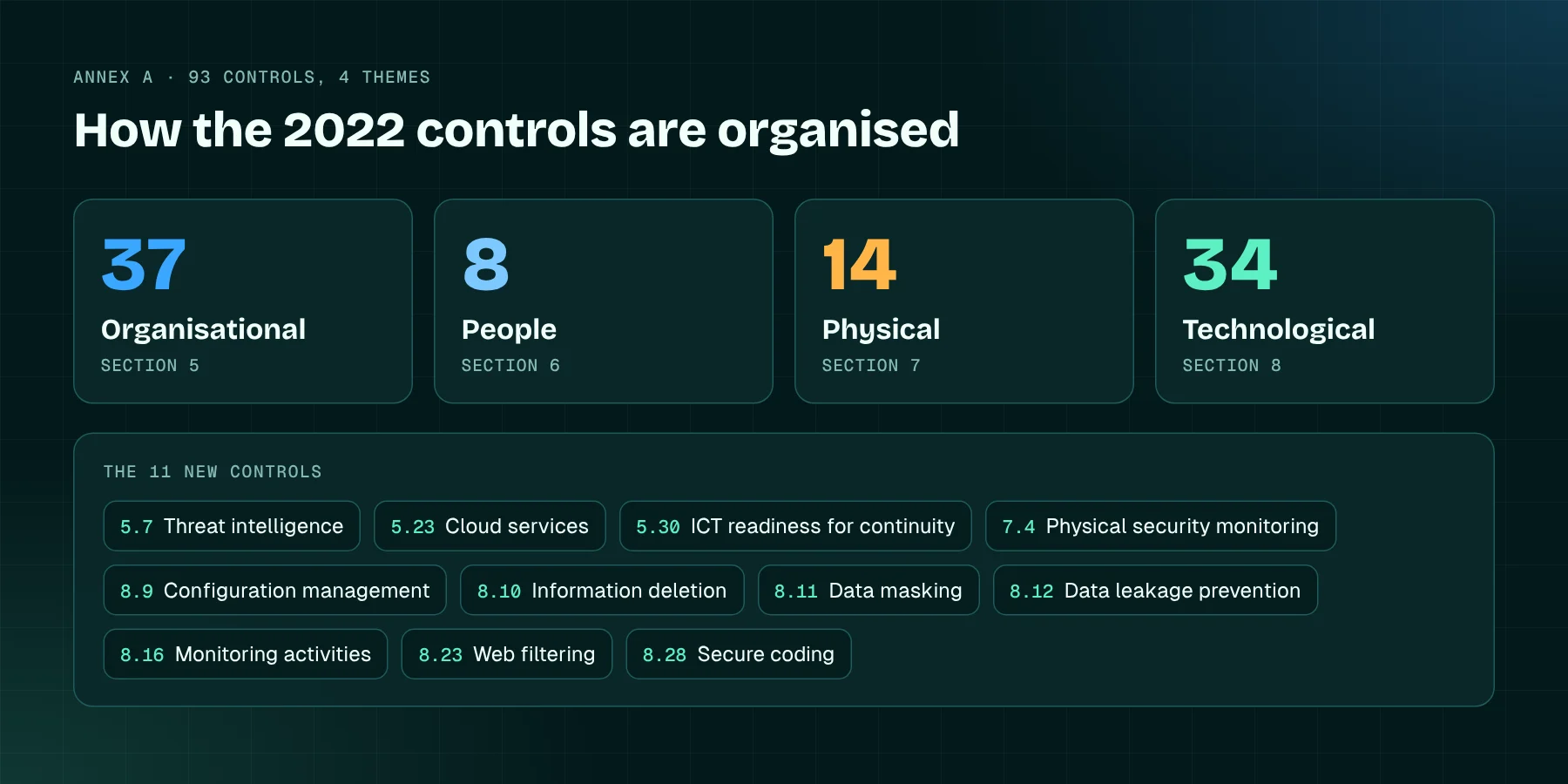
The new controls are where quick transitions show their seams. It's easy to write a threat intelligence policy. It's harder to show that someone reads the alerts and that something changed as a result.
The weak spots
1. The asset inventory doesn't match reality (5.9)
Control 5.9, inventory of information and other associated assets, sounds like admin. It's actually the foundation everything else rests on. Your risk assessment under clause 6.1.2 is only as good as the list of things you're protecting.
The typical gap: a spreadsheet of laptops and servers, last updated at the transition, with no sign of the software-as-a-service tools the business actually runs on. Finance has its own platform, marketing signed up to three tools on a credit card, and nobody added them.
What good looks like: one inventory that includes information and cloud services, not just hardware, with a named owner for each entry and a review date that's actually been met.
2. Cloud services treated as someone else's problem (5.23)
Control 5.23, information security for use of cloud services, is new, and it's the one we'd say most SMEs underestimate. The control expects you to govern how cloud services are acquired, used and, eventually, exited.
In practice that means: do you know which cloud services hold sensitive data? Did anyone check the provider's security before signing up? Have you configured it properly, or are you running on defaults? And if you had to leave, could you get your data out?
The exit question is the one that usually goes unanswered. It's also the one that bites hardest when a provider changes its terms or has a bad week.
3. Supplier checks done once, then forgotten (5.19 and 5.22)
Most businesses can show some due diligence when a supplier was first taken on. Far fewer can show the ongoing part that 5.22, monitoring, review and change management of supplier services, asks for.
If your critical suppliers were assessed three years ago and haven't been looked at since, that's a gap. So is a supplier that has changed its own sub-processors or hosting without you noticing.
A proportionate fix: tier your suppliers. Review the handful that really matter every year, with a short record of what you checked. Don't try to audit the stationery company.
4. Access reviews that never happened (5.18 and 8.2)
Access rights (5.18) and privileged access rights (8.2) are old favourites, and they haven't stopped being weak. The usual story is a leaver whose account was disabled weeks late, or an admin account that three people share.
Policies almost always say access is reviewed periodically. The evidence that it was is often missing. A dated record of who reviewed which system, what they found and what they changed is all it takes.
5. Logs nobody looks at (8.15 and 8.16)
Logging (8.15) is often already switched on in the cloud platforms you use. Monitoring activities (8.16) is the new control, and it's about whether anyone watches for unusual behaviour and acts on it.
For a small business this doesn't mean a security operations centre. It might mean alerting set up for risky sign-ins in your email platform, a named person who gets those alerts, and a simple record of what they did about them. The weakness we see isn't missing tools, it's missing ownership.
6. Patching without proof, configuration without a baseline (8.8 and 8.9)
Management of technical vulnerabilities (8.8) is usually in reasonable shape for businesses that also hold Cyber Essentials, because the patching expectations overlap. Configuration management (8.9), another new control, is weaker. It expects configurations, including security settings, to be established, documented, monitored and reviewed.
If your laptops are set up by whoever happens to be in the office that day, there's no baseline. Writing down a standard build, even a single page, and checking new devices against it is a good start.
7. Backups that have never been restored (8.13 and 5.30)
Everyone backs up. Fewer people have tested a restore, and fewer still have a dated record of the test. Information backup (8.13) expects backups to be maintained and tested, and ICT readiness for business continuity (5.30), new in 2022, expects ICT continuity to be planned, implemented and tested.
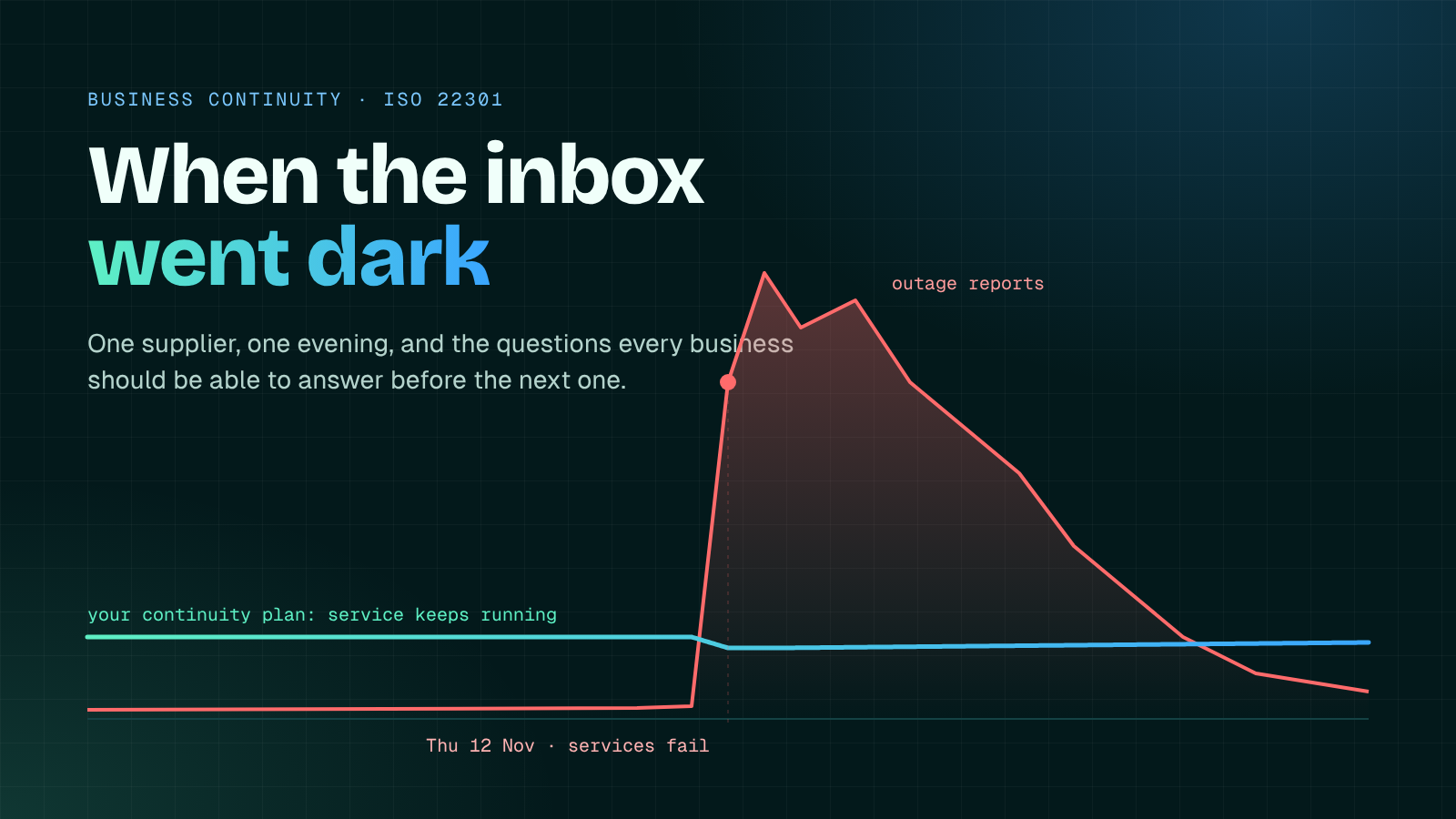
We wrote about this from a continuity angle after the Microsoft 365 outage earlier this month. The short version: if your recovery plan has never been tried, it's a hope rather than a plan.
8. The management system itself
The clauses still trip people up as much as Annex A. The patterns we see most:
- Internal audit (9.2) that's really a checklist run by the person who wrote the policies, so it's never really an objective look.
- Management review (9.3) minutes that list the required inputs but show no decisions, actions or resources agreed.
- Planning of changes (6.3) with no record at all. A new office, a new main system or a merger should leave some trace of how the ISMS was adjusted.
- Climate change (4.1) considered nowhere. For many businesses the honest answer is that it's a minor issue, but you still need to have considered it and be able to say why.
- Lessons from incidents (5.27) missing, because small incidents weren't logged in the first place.
What to do in the next 90 days
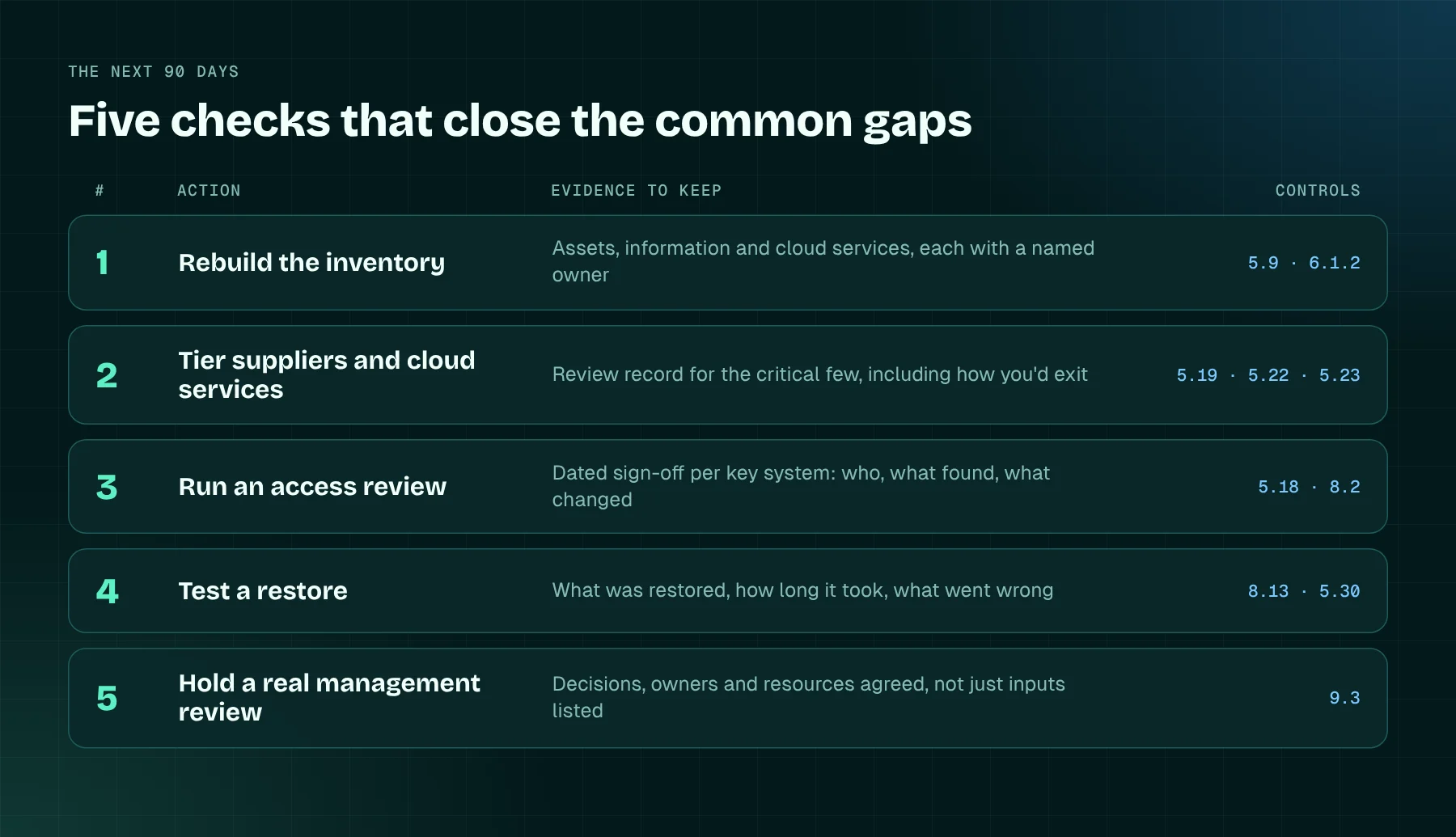
You don't need to fix everything at once. If your next audit is within the year, this order gets the most value for the least effort.
- Rebuild the inventory. Include cloud services and information, not just kit. Give every entry an owner. Then check your risk assessment still reflects it.
- Tier your suppliers and cloud services. Pick the five or ten that really matter. For each, record what you checked, when, and how you'd exit.
- Run one access review per key system. Date it, sign it and keep it. Then put the next one in the diary.
- Test a restore. Pick something that matters, restore it somewhere safe, time it, and write down what happened.
- Hold a proper management review. Use it to decide on the gaps above, assign owners and agree resources. That record is evidence in its own right.
Notice that most of these are about evidence. In our experience, small businesses rarely struggle because the control is missing. They struggle because they can't show it working.
How BK17 can help
BK17 builds it. TheMS runs it. Our consultants work with you to tighten the parts of your ISO 27001 system that a quick transition left thin: the inventory, cloud and supplier controls, risk assessment and the clause-level routines that hold it together. We advise and prepare; certification audits are carried out by an accredited certification body.
TheMS, our compliance management system, then keeps it running: owners, review dates, access reviews, supplier checks, restore tests and management review actions all in one place, with the evidence attached. If you run other standards such as ISO 9001 or ISO 14001, they sit in the same system. That's 1 system, 1 login, 1 renewal, which is how a business without a compliance department keeps an ISMS alive between audits.
If your 2022 transition was more of a sprint than a rebuild, talk to us about where it might be thin.
Explore topics
Written by
BK17 Editorial
Content creator and writer sharing insights and stories.